Top AI Agent Development Companies in India: Complete Guide for Businesses

TL;DR
Most firms selling "agentic AI" just wrap APIs. This guide covers the top AI agent development companies in India for 2026, the five questions that separate real orchestration from marketing, cost bands from $10K POCs to $75K+ systems, and how to shortlist a partner that ships agents to production.
Top AI Agent Development Companies in India: Complete Guide for Businesses
AI agent development companies in India are building something categorically different from what the market called "AI" two years ago. A chatbot answers a question. An AI agent takes a goal, plans a sequence of steps, calls external tools, recovers when a step fails, and returns a result a human can act on. That gap is the entire story of this guide.
It's also where most buyers get burned. The term "AI agent" now covers an enormous range — from a chatbot with tool-calling bolted on, to a genuine multi-agent system with a planner, specialized executors, a memory layer, and a defined failure-recovery strategy. A large share of firms in the market cluster at the chatbot end and use "agentic" as a marketing modifier. Choosing the wrong vendor on that basis can cost six to twelve months.
This guide covers the top AI agent development companies in India for 2026, what separates real orchestration work from API wrappers, the questions that expose the difference in a single call, realistic cost bands, and how to shortlist a partner that can actually ship autonomous systems into production.
What is an AI agent, and how is it different from generative AI?
Generative AI is reactive. You prompt it, it responds, the exchange ends. Agentic AI is proactive. It receives a goal, decomposes it into sub-goals, selects and calls tools, evaluates its own output, and adapts across multiple decisions without a human approving each step.
The practical difference is the gap between asking a junior employee "what was Q3 revenue?" and asking a senior analyst "prepare a competitive analysis report by Friday." The second requires planning, research, synthesis, and independent judgment. That is what an AI agent does.
Four capabilities define a production-grade agent:
Perception. It ingests context from data sources, APIs, documents, and system state — not just a single text prompt.
Reasoning and planning. It breaks a goal into an ordered sequence of steps and decides which tools each step requires.
Autonomous action. It executes across multiple systems — updating a CRM, issuing a refund, generating a purchase order — without human intervention at each stage.
Memory and adaptation. It retains context across a session (and often across sessions), learns from failures, and recovers from partial errors rather than halting.
Why AI agent development in India is scaling fast
The demand signal is unambiguous. Deloitte reports that more than 80% of Indian organizations are now exploring autonomous agent development, with 70% pursuing GenAI-driven automation. Among India's Global Capability Centres — the captive engineering hubs of global enterprises — the EY GCC Pulse Survey found 83% actively engaging with GenAI adoption and 58% already developing agentic capabilities.
The market math follows. India's AI market is projected to exceed $17 billion by 2027 per Boston Consulting Group, and Gartner predicts that by 2028, at least 15% of day-to-day work decisions will be made autonomously by agentic AI systems.
Three structural shifts made 2026 the year agents became viable rather than experimental:
Models stopped hallucinating on structured tasks. Frontier models are now reliable enough for multi-step tool use in production, which was the single biggest blocker in earlier agent attempts.
Orchestration frameworks standardized. LangChain, LangGraph, AutoGen, CrewAI, and Model Context Protocol (MCP) turned agent architecture from custom plumbing into a known pattern.
API costs collapsed. Inference costs have dropped dramatically from 2023 levels, making high-volume agentic pipelines economically viable — not just for enterprises, but for mid-market companies too.
Layer on cost efficiency of roughly 40% to 60% below comparable US and UK firms, and India becomes the most commercially viable geography for agent projects at almost any scale.
Top AI agent development companies in India (2026)
1. Craxinno Technologies
Craxinno is an AI-first product engineering agency headquartered in Jaipur, serving primarily US and UK clients. The team builds agentic systems on a production stack — Claude and Claude Code, OpenAI, LangChain, and RAG architectures — wired into real product surfaces built with React, Next.js, Node.js, and TypeScript. Voice-agent work runs on Vapi, ElevenLabs, and AssemblyAI.
What distinguishes the practice is that agents ship inside real products rather than as standalone pilots. With 8+ years of delivery, 120+ clients, 210+ projects, and Top Rated status on Upwork at a 94% Job Success Score, the team is built for companies that need an autonomous system running in production, not a sandbox demo. Recent AI-forward builds are documented in the Craxinno portfolio, and the full capability set is outlined on the Craxinno services page.
Best for: Startups and mid-market teams embedding AI agents into SaaS, web, and mobile products — customer operations, voice agents, and workflow automation.
2. Fractal Analytics
One of India's earliest enterprise AI companies, Fractal pairs decision science with agentic deployment for Fortune 500 clients. It launched Fathom-R1-14B, an open-source reasoning-focused LLM, and is developing a large-scale reasoning model under the IndiaAI Mission. Reasoning depth is the differentiator here — relevant for agents that must justify decisions in regulated contexts.
Best for: Large enterprises needing agentic AI with decision-science rigor and auditability.
3. Infosys (Topaz)
Infosys has folded agentic capability into its Topaz AI suite, targeting enterprise process automation at scale. AI now represents roughly 5.5% of Infosys revenue. Its strength is deploying agents across sprawling legacy estates where the integration surface — not the reasoning layer — is the hard part.
Best for: Enterprises automating processes across complex legacy systems.
4. Tata Consultancy Services (TCS)
TCS reports AI revenue at roughly $1.8 billion on an annualized run rate. For agentic work, its advantage is governance: multi-year rollouts in regulated industries where autonomous action requires audit trails, compliance sign-off, and defined human-in-the-loop checkpoints.
Best for: Regulated enterprises needing agentic automation with compliance-grade governance.
5. Yellow.ai
Yellow.ai operates in conversational and agentic automation across 135+ languages, with deep deployment in customer operations. Where it wins is high-volume, multilingual customer-facing agents — resolving issues end to end rather than deflecting to a human queue.
Best for: Consumer businesses deploying autonomous customer support at scale.
6. Uniphore
A conversational AI unicorn, Uniphore has extended into agent-assist and autonomous workflows for customer engagement, with emotion detection and multilingual support built in. Its footprint is strongest in contact-center transformation.
Best for: Enterprises modernizing contact centers with autonomous and agent-assist systems.
7. LeewayHertz
LeewayHertz offers broad AI capability coverage with meaningful agentic and multi-agent orchestration work across industries. It's a common shortlist entry for companies that want one partner spanning agents, LLM apps, and supporting data infrastructure.
Best for: Companies wanting broad AI coverage alongside agent development.
8. Maruti Techlabs
Maruti Techlabs brings full-stack AI with a strong delivery track record, working across agentic automation, ML, and product engineering. It sits comfortably in the mid-market band — more structured than a boutique, faster than an enterprise integrator.
Best for: Mid-market companies needing reliable delivery on agentic automation.
9. Openxcell
With 400+ AI specialists and 1,500+ projects delivered since 2009, Openxcell covers LLM development, RAG pipelines, multi-agent systems, NLP, and computer vision. Its scale suits companies that effectively want a large in-house AI team without the hiring overhead.
Best for: Companies needing in-house-scale agent capability without direct hiring.
10. Sarvam AI
Sarvam is building sovereign AI infrastructure and India-specific foundation models, backed by significant funding and selected under the IndiaAI Mission. It's less a services vendor than an infrastructure and model partner — relevant if your agent strategy depends on India-native language models or data-residency constraints.
Best for: Organizations with sovereign AI, data-residency, or Indic-language requirements.
The five questions that separate real agent builders from API wrappers
This is the highest-leverage section of this guide. Ask these five questions on the first call, and the shortlist sorts itself.
Can you show a production agent, not a sandbox demo?
A firm with real agentic experience will name the system, the workflow it owns, and what happens when it fails. A firm without one will show a capabilities deck.
What orchestration framework do you use, and why?
LangGraph, AutoGen, CrewAI, and MCP each involve real tradeoffs. A team that has made a considered choice — in either direction — and can explain the tradeoffs has thought about architecture at the right level. A team that hasn't heard of Model Context Protocol is building 2024 infrastructure in 2026.
How do you handle agent failure modes?
Hallucination, prompt injection, partial-step failure, and infinite loops are the four ways agents break in production. A serious answer names specific mitigations. A vague answer means you'll be the project where they learn.
What's your observability stack?
Agents that cannot be observed cannot be debugged. A specific answer — OpenTelemetry, per-tool error rates, session trace correlation — indicates production maturity. "We check the logs" is a warning sign.
Will you propose an orchestration architecture before the engagement starts?
A firm with genuine expertise will ask clarifying questions, identify edge cases, and propose a specific approach with tradeoffs. A firm without it will send a timeline and a slide deck.
The most common failure point in agentic AI isn't the reasoning layer — it's the integration surface around it. Autonomy is only as reliable as the weakest link in the tool chain. Evaluate vendors on integration discipline, not model enthusiasm.
What AI agent development costs in India (2026)
Pricing depends on how many systems the agent touches and how much autonomy it's granted. Realistic 2026 bands:
Proof of concept: $10,000 to $30,000. A single-workflow agent with limited tool access, built to validate feasibility.
Production agent MVP: $25,000 to $75,000. One well-scoped autonomous workflow with real integrations, error handling, and monitoring.
Multi-agent enterprise system: $75,000 and up. Planner-executor architecture, multiple integrations, human-in-the-loop checkpoints, and full observability.
Hourly rates for established Indian agentic teams commonly sit at $25 to $50 — roughly 40% to 60% below comparable US and UK firms. Budget separately for recurring model inference costs, which scale with agent usage rather than sitting flat like traditional software.
A realistic timeline for a production agent is three to six months from scoping to stable deployment. Vendors promising a two-week production agent without seeing your data or integrations are either guessing or padding.
Where AI agents are delivering results in 2026
Customer operations. Agents that look up an order, check stock, issue a refund, update the CRM, and send confirmation — end to end. Not deflection; resolution.
Finance and BFSI. Fraud detection, underwriting support, and reconciliation agents operating across core systems with human checkpoints at decision boundaries.
Software engineering. Agentic coding tools that write, test, debug, and document code, meaningfully compressing cycle time on well-defined tasks.
Supply chain. Agents monitoring inventory, forecasting demand, generating purchase orders, and comparing supplier quotes autonomously.
Healthcare. Diagnostic support, intake automation, and documentation agents operating under compliance constraints.
How to shortlist your AI agent development partner
Start by scoping the workflow, not the technology. The best agent projects begin with a specific, measurable process — one with clear inputs, clear success criteria, and a real cost of doing it manually today.
From there, three filters narrow the field quickly. Domain fit matters more than it does in general software: an agent operating in fintech or healthcare has to handle compliance and failure consequences that a generic team hasn't encountered. Integration depth matters more than model choice, because the tool chain is where agents break. And commercial clarity — milestone-based scoping rather than open-ended hourly — is the single best predictor of whether an agent project lands on time.
If you're also evaluating partners for broader AI work beyond agents, our guide to the best AI development companies in India covers the wider landscape.
Ready to build AI agents that work in production?
If you're scoping an agentic AI build for 2026, the Craxinno team is happy to review your workflow, propose an orchestration approach, and share relevant production case studies. Explore recent work on the Craxinno portfolio, see full capabilities on the services page, or reach out directly at hello@craxinno.com.
Frequently Asked Questions
What are the top AI agent development companies in India?+
Leading AI agent development companies in India include Craxinno Technologies, Fractal Analytics, Infosys, TCS, Yellow.ai, Uniphore, LeewayHertz, Maruti Techlabs, Openxcell, and Sarvam AI. Startups and mid-market teams typically prefer AI-first agencies for speed and production focus, while large enterprises shortlist the IT majors for governance and scale.
What is the difference between AI agents and generative AI?+
Generative AI is reactive — it responds to a single prompt and stops. AI agents are proactive: they take a goal, plan multi-step actions, call external tools, recover from failures, and execute autonomously without human approval at each step.
How much does AI agent development cost in India?+
A proof of concept runs $10,000 to $30,000. A production agent MVP costs $25,000 to $75,000. A multi-agent enterprise system starts at $75,000. Hourly rates for established Indian agentic teams are $25 to $50, roughly 40% to 60% below comparable US and UK firms. Budget separately for recurring model inference costs.
How long does it take to build a production AI agent?+
A realistic timeline is three to six months from scoping to stable production deployment. A proof of concept can ship in three to six weeks. Any vendor promising a production agent in two weeks without reviewing your data and integrations is guessing.
What frameworks do AI agent development companies use?+
The standard stack includes LangChain, LangGraph, AutoGen, and CrewAI for orchestration, with Model Context Protocol (MCP) increasingly used for tool integration. Production teams pair these with observability stacks such as OpenTelemetry for session tracing and per-tool error monitoring.
How do I know if an AI agent company is legitimate?+
Ask for a production agent (not a sandbox demo), their orchestration framework and why they chose it, how they handle hallucination and prompt injection, their observability stack, and whether they'll propose an architecture before the engagement starts. Vague answers on any of these are disqualifying.
Building something with AI?
We ship production AI — agents, RAG pipelines and LLM integrations that survive real users, not demos.
Start a projectKeep ReadingMore case studies like this
Engineering retros, product launches, and brand systems from our studio — updated monthly.
All case studiesTechnology Used
 HTML5
HTML5 Redux
Redux Material UI
 Bitbucket
 Figma
Figma Adobe XD
 Sketch
 Tags & Keywords
Continue with Blogs.
View all blogs AWS
AWSAWS S3 Backup Strategy: Best Practices for 2026
Quick answer: A solid AWS S3 backup strategy in 2026 has four layers. Turn on S3 Versioning with lifecycle limits. Run AWS Backup with continuous plus snapshot rules. Copy recovery points into a logically air-gapped vault in a separate account and Region. Then test restores on a schedule, because an untested backup is a guess. That's the whole strategy in one paragraph. The rest of this guide covers the decisions behind each layer, what each one costs, and the gaps AWS doesn't advertise loudly. Key takeaways S3's 11 nines of durability protects you from AWS losing your data. It does nothing when you (or an attacker with your keys) delete it. Replication is not a backup. It copies mistakes as fast as it copies good data. AWS Backup's continuous mode gives point-in-time restore for up to 35 days. Snapshots cover anything longer, up to 99 years. The low-cost warm tier (launched November 2025) cuts long-term S3 backup storage by up to 30%. Since August 2026 you can read backup data through S3 Access Points without running a full restore. That changes how cheaply you can test. Why "11 nines" isn't an S3 backup strategy Here's the conversation we keep having with founders. "We're on S3. It's 99.999999999% durable. Why would we need backups?" Then picture this. A developer runs a cleanup script against the wrong bucket on a Friday evening. Or an IAM access key leaks in a public repo, and someone encrypts or deletes every object they can reach. S3 performs those deletes with the same 11-nines reliability it uses to store your files. Durability worked perfectly. Your data is still gone. Durability is a promise about hardware. A backup is a promise about your ability to undo things . Those are different contracts, and the AWS shared responsibility model puts the second one on you. So the real question for an AWS S3 backup strategy is: what are you recovering from? Start with the threat model, not the tools Most S3 backup setups we audit were built tool-first. Someone enabled versioning, someone else added replication, and nobody wrote down what failure each piece was supposed to handle. Flip it. List the failures, then pick the control. Failure you need to survive What actually protects you What does NOT Accidental overwrite or delete of a few objects S3 Versioning Replication (it replicates the overwrite) Bad deploy corrupts thousands of objects over hours AWS Backup continuous (point-in-time restore) Versioning alone (painful to roll back at scale) Leaked credentials, ransomware, malicious insider Immutable copy in a separate account (air-gapped vault, Object Lock compliance mode) Anything in the same account the attacker controls Full Region outage Cross-Region copy or Cross-Region Replication Same-Region backups Compliance audit asking for 7-year retention AWS Backup snapshots with Vault Lock Lifecycle rules that quietly expire data Then set two numbers for each data set: RPO (Recovery Point Objective): how much data you can afford to lose. 15 minutes? A day? RTO (Recovery Time Objective): how long you can be down while restoring. Don't set one RPO for the whole company. Your user-uploaded files and your build-artifact bucket deserve very different treatment, and pricing them the same is how backup bills get out of hand. The 11 AWS S3 backup best practices for 2026 1. Tier your buckets before you back up anything Tag every bucket with a data tier. We use three: Tier 1: data the business can't run without (customer uploads, invoices, medical or financial records). Continuous backup, air-gapped copy, tight RPO. Tier 2: important but rebuildable with effort (analytics exports, processed media). Daily snapshots, cross-Region copy. Tier 3: reproducible from source (build artifacts, caches, logs you already ship elsewhere). Versioning with short retention, or no backup at all. Skipping backup for Tier 3 is a legitimate decision. Write it down so it reads as a choice, not an oversight. 2. Turn on versioning, then put a ceiling on it AWS Backup for S3 requires S3 Versioning. So does Object Lock. That makes versioning non-negotiable. But versioning without lifecycle rules is a slow cost leak. Every overwrite keeps the old copy forever. On a bucket that rewrites the same JSON file every minute, you'll pay for roughly 43,000 versions of it per month. Two lifecycle rules fix most of this: 1 2 3 4 5 6 7 8 9 10 { "Rules" : [ { "ID" : "expire-noncurrent-versions" , "Status" : "Enabled" , "Filter" : { } , "NoncurrentVersionExpiration" : { "NoncurrentDays" : 30 } , "Expiration" : { "ExpiredObjectDeleteMarker" : true } , "AbortIncompleteMultipartUpload" : { "DaysAfterInitiation" : 7 } } ] } The ExpiredObjectDeleteMarker line matters more than it looks. AWS Backup bills each delete marker as if it were a 128 KiB object, so orphaned markers on a high-churn bucket add up. Pick the NoncurrentDays value with care. Once a version expires, AWS Backup can't restore it either. Your noncurrent retention should be at least as long as your shortest RPO window. (For the exact console and CLI steps, see our AWS S3 backup setup guide .) 3. Use AWS Backup with continuous and snapshot rules together AWS Backup has two modes for S3, and the right answer for Tier 1 data is both: Continuous backup tracks changes through EventBridge and lets you restore to any point in the last 35 days . This is your "undo the bad deploy from Tuesday at 14:20" button. Snapshot (periodic) backup runs on a schedule (hourly, daily, weekly, monthly) and can be retained for up to 99 years . When both rules sit in the same backup vault, AWS Backup builds snapshots from the continuous recovery point. You get long retention without scanning the whole bucket again or paying for duplicate storage. AWS's own guidance recommends this combined setup. Two setup traps we see often: EventBridge isn't enabled on the bucket. Continuous backup silently depends on it. Check with aws s3api get-bucket-notification-configuration and look for "EventBridgeConfiguration": {} . The same bucket sits in two backup plans with continuous rules. AWS supports one continuous backup per bucket. Keep continuous and periodic recovery points in the same vault. 4. Keep one copy outside the blast radius This is the practice that separates a real AWS S3 backup strategy from a checkbox. If your backups live in the same AWS account as production, anyone with admin on that account can delete them. Ransomware crews know this. They go after the backups first. The fix in 2026 is the AWS Backup logically air-gapped vault : Recovery points are locked by default and encrypted with AWS-owned keys, or with your own KMS key since November 2025. Since November 2025 you can send primary backups directly into the air-gapped vault, so you don't pay for a second copy in a standard vault first. With multi-party approval (June 2025), a team of approvers across your AWS Organization can grant recovery access even if the source account is fully compromised or locked out. AWS added six more Regions for these vaults in July 2026, so availability is much less of a blocker than it was at launch. Our default layout: production account, a dedicated backup account in a second Region, and the air-gapped vault in that backup account. Nobody's day-to-day IAM role touches the backup account. 5. Make backups immutable on purpose You have two immutability tools, and they protect different things. S3 Object Lock works on the bucket itself. In compliance mode , no user, including the root account, can delete or shorten retention on a locked object version until the retention date passes. In governance mode , users with s3:BypassGovernanceRetention can override it. Governance mode is fine for testing. For ransomware protection, use compliance mode, and be sure about the retention period, because you can't undo it. AWS Backup Vault Lock works on recovery points in the backup vault. In compliance mode it stops anyone from deleting backups early or changing the retention policy once the cooling-off period ends. For Tier 1 data, we'd use Vault Lock (or the air-gapped vault) on the backups and save Object Lock for buckets with a regulatory write-once requirement. Object Lock on a busy production bucket can lock you into paying for data you'd love to delete. 6. Don't confuse replication with backup S3 Cross-Region Replication (CRR) is excellent at one job: keeping a live copy in another Region for failover. With S3 Replication Time Control , AWS replicates 99.99% of objects within 15 minutes. But look at what it does with bad changes: Ransomware overwrites 2 million objects with encrypted versions. CRR copies the encrypted versions. An app bug writes empty files. CRR copies the empty files. Delete marker replication is optional. Permanent deletes of specific versions are never replicated, which helps a little, but an attacker with access to both buckets doesn't care. CRR also has no built-in point-in-time restore. Rebuilding a bucket "as of last Tuesday" from replicas means stitching together S3 Inventory and Batch Operations by hand. Use CRR when your RTO is minutes and you need a hot standby. Pair it with AWS Backup for the "go back in time" requirement. One is availability, the other is recoverability, and you usually need both. 7. Assign backups by tag, so new buckets aren't forgotten The bucket that loses data is rarely the one you planned for. It's the one a developer created six months ago for "a quick feature." Assign resources to AWS Backup plans by tag (for example backup-tier = tier1 ), not by listing bucket ARNs. Then enforce the tag: Add it to your Terraform or CloudFormation bucket module so every new bucket gets one. Use AWS Backup Audit Manager or an AWS Config rule to flag buckets that have no backup tier tag. For multi-account setups, push backup policies through AWS Organizations so new accounts inherit them. 8. Cut storage costs with the warm tier and smarter retention AWS Backup storage for S3 runs about $0.05 per GB-month in US East (N. Virginia), against $0.023 for S3 Standard itself. Backups can easily cost more than the bucket they protect. A few levers: Turn on the low-cost warm tier. Launched November 2025, it moves backed-up objects that have been in the vault at least 60 days to a tier about 30% cheaper (roughly $0.035 per GB-month in AWS's example), with the same restore speed. There's a one-time fee of about $0.01 per 1,000 objects to transition. Watch small objects. Objects under 128 KB are billed as 128 KB, even in the warm tier. A bucket of millions of tiny thumbnails is a bad warm-tier candidate, and sometimes a bad AWS Backup candidate overall. Exclude ACLs and object tags if you don't need them restored. AWS Backup lets you disable both in advanced backup settings. Delete expired recovery points and partial backups. They keep billing until they're gone. AWS published a worked example worth stealing for your own business case: 500 TB and 1 billion objects in US East, 80% of objects tiered. Monthly backup storage dropped from $25,600 to $19,456. The $8,000 transition fee pays for itself in under two months. 9. Get encryption and key access right Encryption is where restores fail at 2 a.m. SSE-S3 and SSE-KMS objects back up fine. With SSE-KMS, the AWS Backup role needs kms:Decrypt on the source key, and you'll see those calls in CloudTrail. SSE-C (customer-provided keys) is not supported by AWS Backup. If any of your buckets use it, you need a different backup path for those objects. If you use a customer-managed KMS key for an air-gapped vault, protect that key's policy as carefully as the vault itself. Losing the key means losing the backup. One more trap: if CloudTrail data events or S3 server access logs are enabled for a backed-up bucket, deliver them to a different bucket. Logging into the bucket being logged creates an endless write loop, and AWS Backup will dutifully back up every log line. 10. Know what AWS Backup does NOT back up This list surprises almost every team we review: Bucket configuration: bucket policies, CORS, lifecycle rules, access points and bucket settings are not included. Restore gives you objects, not the bucket as it was. S3 Glacier Flexible Retrieval and Glacier Deep Archive objects are not supported. Directory buckets (S3 Express One Zone) and S3 on Outposts are not supported. General purpose buckets only. Restored objects don't keep their original version ID, creation date, storage class, or ETag. The answer for bucket configuration is infrastructure as code. If your buckets live in Terraform or CloudFormation, the config is "backed up" in Git. If they were clicked together in the console, fix that before you need a restore. 11. Test restores like you mean it Every backup strategy looks great until the first restore. Teams find out during the incident that the IAM role can't decrypt the KMS key, or that the restore of 40 million objects needs a service limit increase, or that the "daily" backup job failed silently three weeks ago. What changed in 2026 is how cheap testing has become: Backup access points (August 2026). AWS Backup can now create read-only S3 Access Points on a recovery point. You can run GetObject , HeadObject and ListObjectsV2 against backup data directly, with no restore job. That's perfect for spot-checking files, validating data, or forensics after an incident. The recovery point can't be deleted while an access point is active. AWS Backup restore testing runs scheduled restores into an isolated environment and records whether they worked. Amazon GuardDuty Malware Protection for AWS Backup (November 2025) scans recovery points for malware before you restore, so you don't restore the infection along with the data. A simple cadence we recommend: automated restore tests monthly for Tier 1, quarterly for Tier 2, and one full game-day restore of a Tier 1 bucket every year with a stopwatch running. Compare the result against the RTO you wrote down in step one. Sample S3 backup strategies by company stage Not everyone needs the full stack on day one. Here's how we'd scale it. Early-stage startup Growing SaaS Regulated / enterprise Versioning + lifecycle Yes Yes Yes AWS Backup Daily snapshots, 30-day retention Continuous + daily snapshots Continuous + daily/monthly snapshots, multi-year retention Separate backup account Optional Yes Yes, with multi-party approval Air-gapped vault / Vault Lock Nice to have Yes for Tier 1 Required Cross-Region Backup copy only Backup copy + CRR for Tier 1 CRR with RTC + backup copy Restore testing Quarterly manual check Monthly automated Monthly automated + annual game day + audit reports If you're still picking your stack, our SaaS tech stack guide for 2026 covers where S3 fits next to your database and hosting choices. Common S3 backup mistakes we keep finding Backups in the same account as production. The single most common gap, and the one ransomware exploits. Lifecycle rules shorter than the RPO. Old versions expire before anyone notices the corruption. No alert on failed backup jobs. Wire AWS Backup job events to EventBridge and send failures to Slack or PagerDuty. Assuming Glacier objects are covered. They aren't. Never timing a restore. Your RTO is a guess until you've measured it. These are the same kind of quiet failures we wrote about in the real cost of bad software : cheap to prevent, very expensive to discover late. Need a second pair of eyes on your S3 backups? At Craxinno we design and ship cloud infrastructure for startups and growing businesses, including AWS Backup plans, multi-account setups and restore runbooks. If you'd like us to review your current setup against the checklist above, talk to our team and we'll tell you where the gaps are.
 Hire AI Developers
How to Hire AI Developers in India (2026 Guide)
How to Hire AI Developers in India (2026 Guide) Quick answer: To hire AI developers in India in 2026, first define the exact AI role you need (LLM app developer, ML engineer, MLOps or data engineer), choose a hiring model (freelancer, agency, dedicated team or EOR hire), screen for shipped production work, run a short paid test, then lock IP and data terms before day one. Expect $25 to $75 an hour for most mid-to-senior work. That's the short version. The long version matters because "AI developer" now covers everything from someone who wires the OpenAI API into a chatbot over a weekend to an engineer who can fine-tune a model, build an evaluation suite and keep inference costs under control at 50,000 requests a day. Hire the first when you need the second and you'll find out three months and a few lakh rupees later. We've been building software out of Jaipur since 2017, and over the last two years most of our new briefs have had an AI component: RAG over company documents, agentic workflows, image generation pipelines on RunPod, Python back ends in FastAPI. This guide is what we'd tell a founder or CTO who asked us how to hire AI developers in India without getting burned, including the parts that don't flatter agencies like ours. Why companies hire AI developers in India in 2026 Cost gets the headlines. Depth is the better reason now. Talent volume: A NASSCOM–Deloitte report projects India's AI talent pool will reach about 1.25 million professionals by 2027, with the domestic AI market roughly tripling to $17 billion. Skill penetration: The Stanford AI Index 2025 ranks India second in the world for AI skill penetration (2015 to 2024), behind only the United States, and first for year-over-year AI hiring growth in 2024 at 33.4%. There's a catch in that same Stanford report. India scored -1.55 on net AI talent migration, meaning more AI professionals leave than arrive. The good people get poached, by GCCs, by foreign employers, by better-funded startups. So the real hiring problem in India isn't finding AI developers. It's identifying the strong ones fast and keeping them. Step zero: figure out which "AI developer" you need Most hiring mistakes we see start here. A founder posts a job for an "AI developer," gets 300 applications, and can't tell them apart because the role was never defined. Role What they actually build Hire them when AI / LLM application developer Chatbots, RAG over your documents , AI features inside web and mobile apps, API integrations with OpenAI, Anthropic or open models You want AI inside a product, quickly, using existing models AI agent developer Multi-step agentic workflows, tool calling, n8n or custom orchestration, human-in-the-loop approvals You're automating a business process end to end Machine learning engineer Custom models, fine-tuning, computer vision, forecasting, recommendation systems Off-the-shelf models don't solve the problem or your data is the moat MLOps engineer Deployment, GPU infrastructure, monitoring, model versioning, cost control Models are going to production and need to stay up Data engineer ETL pipelines, vector stores, data cleaning, warehouses Your data is messy (it almost always is) For most startups and SMBs in 2026, the first hire is an LLM application developer who is also a solid back-end engineer. Not a PhD researcher. You probably don't need to train a model at all, and a researcher who's bored building your CRUD layer will leave in six months. How to hire AI developers in India: 7 steps 1. Write the problem, not the job title Replace "Looking for an experienced AI developer" with something like: "We need a support assistant that answers questions from 4,000 help-centre articles and our Zendesk history, hands off to a human under 70% confidence, and costs under $0.02 per conversation." Now candidates can tell you how they'd build it. And you can compare answers. What goes wrong: vague briefs attract generalists who say yes to everything. Specific briefs make weak candidates self-select out. 2. Pick a hiring model Model Speed to start Best for Main risk Freelancer (Upwork, Contra, LinkedIn) Days Prototypes, one well-scoped feature No backup if they disappear; quality varies wildly Agency / development studio 1–2 weeks Full products where AI is one part of the build (design, front end, back end, AI) Paying for overhead if the agency doesn't specialise in AI Dedicated developer or team (staff augmentation) 1–3 weeks Long-running work under your own product manager You still own the management Direct hire via an Employer of Record (EOR) 4–8 weeks Core, long-term roles you want on your payroll Slow hiring, 30–90 day notice periods, counter-offers Our honest take: if AI is the core of your company, hire in-house eventually. If AI is a feature inside a bigger product, an agency or dedicated team gets you to production faster because you also need design, front end, DevOps and QA, and hiring all of those one by one is slow. 3. Screen for production evidence, not certificates Certificates and Kaggle ranks tell you someone can study. You want proof they've shipped. Ask every shortlisted candidate for one AI system that real users touched, then ask: How many users or requests did it handle? How did you measure whether answers were correct? What did it cost per request, and what did you do to bring that down? What broke after launch? Someone who has actually run AI in production answers the last question instantly, usually with a slightly pained smile. Hallucinated citations. A vector index that went stale. A prompt that worked in English and fell apart in Hinglish. Someone who has only built demos gets vague. 4. Run a short, paid practical test Skip the LeetCode round. Give a 4 to 6 hour task that mirrors your real work, and pay for it. Paying signals respect and gets you better candidates, especially senior ones who won't do free homework. A test we like for LLM application roles: "Here are 30 PDF policy documents and 20 questions with expected answers. Build a small RAG service with an API endpoint. Include a script that scores your answers against ours, and write half a page on what you'd change before production." The half-page matters more than the code. You're looking for someone who mentions chunking strategy, retrieval evaluation, citation of sources, cost per query and failure handling without being prompted. 5. Interview questions that separate engineers from API wrappers "When would you not use an LLM for this?" (Good engineers have opinions. Rules and regex still win sometimes.) "How would you evaluate a RAG system before launch?" (Listen for a test set, retrieval metrics and human review, not "I'd try some questions.") "Our token bill doubled last month. Walk me through what you'd check." (Caching, prompt length, model routing, retries.) "How do you stop prompt injection in an agent that can send emails?" (Permission scoping and human approval for risky actions.) "Fine-tuning or RAG for our use case, and why?" Then the boring question that predicts success better than any of the above: "Show me a pull request you're proud of." Clean back-end code is most of an AI product. 6. Lock the contract: IP, data and compliance Get these in writing before anyone touches your data: IP assignment: all code, prompts, fine-tuned weights and evaluation datasets belong to you. Data handling: where your data is stored, which model providers it's sent to, and whether those providers can train on it. India's DPDP Act 2023: if personal data of Indian users is involved, your vendor needs to process it within the Act's rules. Add GDPR or HIPAA terms if you serve EU or US healthcare users. Access and exit: repo ownership in your GitHub organisation, cloud accounts in your name, and a handover clause. What goes wrong: the code lives in the developer's personal GitHub and the OpenAI key is on their card. We've inherited projects like this. Untangling it costs weeks. 7. Onboard with a 30-day milestone Give the new developer or team one measurable target for the first 30 days, such as "RAG assistant answering the top 50 support questions with 85%+ accuracy on our test set, deployed to staging." A clear milestone surfaces a bad hire in four weeks instead of four months. How much does it cost to hire AI developers in India? Rates vary by role, seniority, city and engagement model. These ranges come from published 2026 rate cards and salary data (Second Talent, Wisemonk, Glassdoor and Indeed figures as reported in their guides), so treat them as a starting point rather than a quote. Hourly rates for international clients Experience Typical rate (USD/hour) Junior (0–2 years) $25–35 Mid-level (3–6 years) $35–50 Senior (6–10 years) $50–75 Lead / principal (10+ years) $70–110 Generative AI and LLM specialists typically command a 15–20% premium over general ML engineers. For comparison, US freelance AI rates commonly run $100 to $200+ an hour. Annual salaries for full-time hires Experience Annual salary (INR) Junior (0–2 years) ₹6–14 LPA Mid-level (3–6 years) ₹15–30 LPA Senior (6–10 years) ₹30–70 LPA Lead / principal (10+ years) ₹60–110 LPA The costs nobody puts in the rate card Employment overhead: for direct hires, budget about 1.3x to 1.4x base salary once statutory benefits, equipment and EOR fees are added. Notice periods: 30 to 90 days is normal in India, and counter-offers of 25–40% are common. Your "hired" candidate may never join. Model and infrastructure spend: LLM API tokens, vector databases and GPU hours are separate from developer cost. A good developer will reduce this bill; a weak one can make it the biggest line item. Rework: a cheap prototype that has to be rebuilt for production is the most expensive option on this list. Red flags when you hire AI developers Every portfolio project is a ChatGPT wrapper with a new UI and no evaluation. They promise a fixed accuracy number before seeing your data. They can't explain how much a feature will cost to run per month. No questions about your data quality, users or edge cases. They want your production data on their own accounts. Estimates for a "full AI agent" in a week. Prototypes, yes. Production, no. Freelancer, agency or in-house: which should you choose? Choose a freelancer if you need a proof of concept in under a month and can review the code yourself. Choose an agency or dedicated team if you need a production product with AI inside it and don't want to hire designers, front-end, back-end and DevOps people separately. Our checklist on how to vet an AI development company covers the questions to ask before signing. Choose an in-house hire (via EOR) if AI is your core product, you have 2+ months to hire, and you can offer a role that keeps a strong engineer interested for years. Plenty of companies do two of these in sequence: an agency builds and launches v1, then the company hires in-house and the agency hands over. Best cities in India to hire AI developers Bengaluru has the largest concentration of AI and data teams and the highest pay, with Hyderabad, Pune, Gurugram, Chennai and Mumbai close behind. Tier-2 cities like Jaipur, Indore and Kochi have smaller senior talent pools but lower costs. For remote work, the city matters far less than the person's track record. Hire AI developers in India with Craxinno Craxinno is an AI-first design and development studio based in Jaipur, India, building since 2017. Our team of 35+ specialists has shipped 200+ projects across SaaS, fintech, e-commerce and mobile. On the AI development side we work with Python (FastAPI, Flask, Django), RAG pipelines, agentic workflows, image generation with Flux, RunPod and AWS deployment, plus the React, Next.js and Node.js work that turns a model into a real product. You can hire a dedicated AI developer or a full product team at $25 per hour , with code in your repository and IP assigned to you from day one. See the projects we've shipped or talk to our team about your AI build .
 App Development Cost
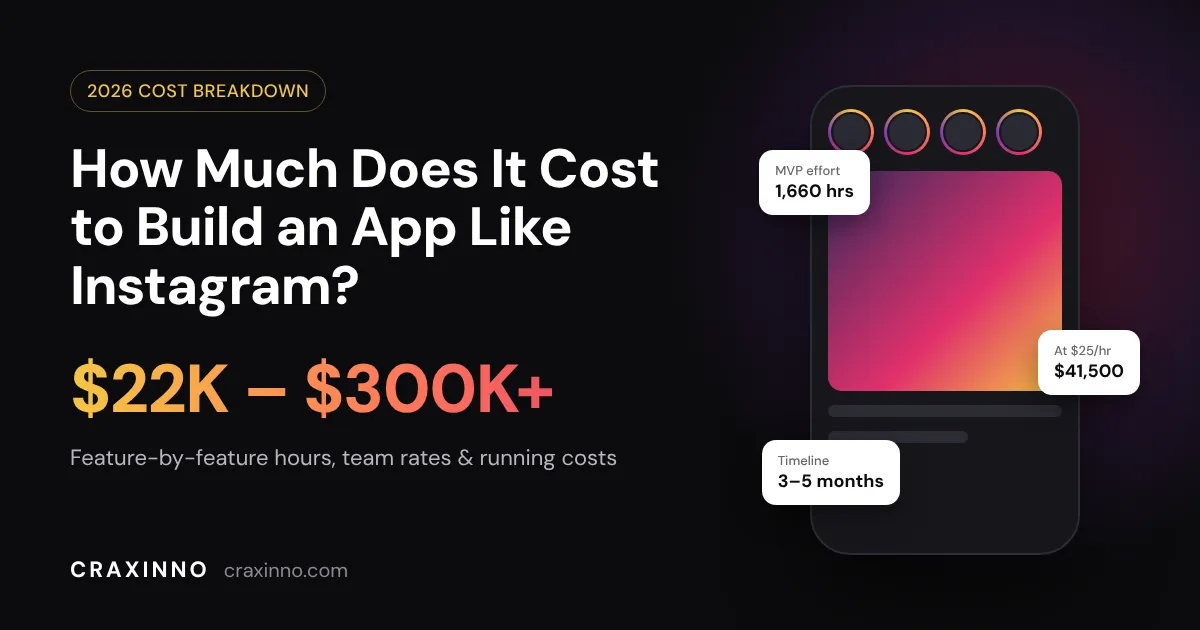
How Much Does It Cost to Build an App Like Instagram?
Quick answer: The cost to build an app like Instagram is roughly $22,000 to $50,000 for an MVP built by an offshore team at $25/hour, and $150,000 to $300,000 for the same scope with a US agency. A full product with Reels-style video, AI feed ranking and live streaming runs $100,000 to $1M+ , depending on who builds it. That's a wide range, and every agency page you've read gives you a different one. So instead of another vague estimate, we did the math in the open: feature-by-feature hours, the same hours priced at three different rates, and the monthly server bill nobody mentions until after launch. Instagram App Cost at a Glance Build tier What you get Effort At $25/hr (India) At $75/hr (E. Europe) At $150/hr (US) Timeline Basic photo app Profiles, photo upload, filters, follow feed, likes, comments 900–1,200 hrs $22.5K–$30K $67.5K–$90K $135K–$180K 2–3 months Instagram-style MVP Basic + Stories, DMs, Explore, push notifications, admin panel 1,500–2,000 hrs $37.5K–$50K $112.5K–$150K $225K–$300K 3–5 months Full platform MVP + short-video feed, ML ranking, live streaming, ads, shopping 4,000–8,000+ hrs $100K–$200K+ $300K–$600K+ $600K–$1.2M+ 9–18 months Look at that table for a second. The scope in each row is identical across the columns. The only thing that changes is the hourly rate, and it moves the price by 6x. Hold that thought; we'll come back to it. Instagram Was Built by 13 People. Your Clone Still Won't Be Cheap Here's the part that confuses founders. Kevin Systrom and Mike Krieger launched Instagram on iOS on October 6, 2010, and roughly 25,000 people signed up on day one. When Facebook bought it for $1 billion in April 2012, the company had 13 employees. So why does a "simple photo app" cost six figures today? Because the 2010 version of Instagram was a photo feed with filters. That's it. No Stories (added in 2016), no Reels (2020), no DMs worth talking about, no shopping, no ads. Today Instagram has more than 3 billion monthly active users, a figure Meta announced in September 2025 , and the app you're comparing against is fifteen years of features stacked on top of that original feed. You don't need fifteen years of features. You need the 20% your users will open the app for. That's where the budget conversation should start. Feature-by-Feature Cost Breakdown Below is a realistic hour estimate for an Instagram-style MVP built cross-platform (one codebase for iOS and Android) with a backend and admin panel. Your own scope will shift these numbers, but the proportions hold up. Feature What it involves Est. hours Cost at $25/hr Discovery + UI/UX design User flows, wireframes, high-fidelity screens, design system 160 $4,000 Sign-up and profiles Email/phone OTP, Google/Apple login, edit profile, follow/unfollow, private accounts 120 $3,000 Photo and video upload Camera, gallery picker, crop, filters, compression, multiple resolutions 200 $5,000 Home feed Following feed, infinite scroll, caching, pull-to-refresh 140 $3,500 Likes, comments, saves, shares Real-time counters, threaded comments, saved collections 90 $2,250 Search and Explore User and hashtag search, a basic trending grid 100 $2,500 Push notifications Likes, comments, follows, DMs via FCM/APNs 50 $1,250 Direct messaging 1:1 real-time chat over WebSockets, media in chat, read receipts 180 $4,500 Stories 24-hour expiry, viewer list, simple text and sticker overlays 120 $3,000 Admin panel + moderation User management, report queue, content takedown, basic analytics 140 $3,500 Backend, media pipeline, DevOps API, database design, CDN, cloud setup, CI/CD, security 180 $4,500 QA and launch Device testing, load testing, App Store and Play Store submission 180 $4,500 Total 1,660 hrs $41,500 For a sanity check: Cleveroad's published estimate puts the core Instagram features at about 1,180 hours per platform , and that excludes design and the admin panel. Ours lands in the same zone once you account for cross-platform development covering both apps at once. Two lines in that table deserve a closer look. Media upload is never "just an upload." A user picks a 12 MB photo from their gallery. Your app has to crop it, compress it, generate three or four sizes (thumbnail, feed, full screen), push them to storage and serve them through a CDN so the feed doesn't stutter on a 4G connection in a small town. Video multiplies all of that, because now you're transcoding too. DMs are a product inside your product. Real-time messaging means persistent connections, delivery states, offline sync and push fallbacks. Founders routinely underestimate it. If messaging isn't the reason people will use your app, push it to version two. What Makes an Instagram Clone Expensive Some features cost a few thousand dollars. Others quietly double the budget. These are the ones that do the doubling: Short-form video (Reels): Vertical video means transcoding into several bitrates, adaptive streaming, autoplay that doesn't drain the battery, and a much bigger bandwidth bill. Expect 400–700+ hours on its own. AI-ranked feed: A chronological feed is a database query. A ranked feed needs event tracking, a recommendation model, and constant tuning. You can start with simple rules (recency plus engagement) and move to ML once you have enough users to learn from. Live streaming: Low-latency video, live comments, moderation in real time. Most teams buy this from a provider like Agora or Mux rather than building it. Content moderation: Once strangers can post photos, you need automated screening (services like AWS Rekognition flag nudity and violence) plus a human review queue. App stores will reject a social app with no reporting system. Two native apps instead of one cross-platform app: Separate Swift and Kotlin codebases take roughly 1.6–2x the effort of a single cross-platform build, according to Scrums.com's benchmarks . For a social MVP, Flutter or React Native is almost always the better call. Why Your Team's Location Changes the Bill More Than Any Feature Go back to the 1,660-hour MVP. Here's the same scope, same features, same quality bar, priced at typical market rates: Team location Typical hourly rate 1,660-hour MVP India (Craxinno) $25 $41,500 Eastern Europe $50–$75 $83,000–$124,500 Western Europe / UK $80–$120 $132,800–$199,200 United States $150–$200 $249,000–$332,000 The gap between the top and bottom of that table is enough to fund a full year of marketing, or your second and third app versions. We're obviously biased here, since we're a studio in Jaipur billing $25 an hour. But the honest version of this advice is the same one we'd give a friend: rate matters less than whether the team has shipped a social app before and talks to you every week. A cheap team that misjudges the media pipeline will cost you more than an expensive one that doesn't. Ask any vendor to walk you through how they'd handle image compression and feed caching. Their answer tells you more than their rate card. The Cost Nobody Quotes You: Running the App Most "cost to build" articles stop at launch day. Your bills don't. Here's a rough monthly infrastructure estimate for a modest app with 10,000 daily active users , using AWS list prices before discounts or free tiers: Bandwidth (the big one): If each user scrolls through about 100 MB of photos and short clips a day, that's 1 TB a day, or roughly 30 TB a month. At CloudFront's US/Europe rates ($0.085/GB for the first 10 TB, $0.080/GB after that), you're paying around $2,450 a month just to deliver media. Storage: Say users upload 2,000 posts a day at about 5 MB each across all resized versions. That's around 300 GB of new data a month. Even after a full year (about 3.6 TB), S3 Standard at $0.023/GB costs roughly $85 a month . Servers, database, real-time chat, push and moderation APIs: typically another $500–$1,500 a month at this scale. Notice the pattern? Storage is cheap. Serving media is what costs money, and it grows with every user who scrolls. That's why aggressive image compression, WebP/AVIF formats and short-video caps aren't technical nice-to-haves; they come straight off your monthly bill. Then add maintenance. Cubix puts annual maintenance at 15–20% of the original build cost, which matches what we see: OS updates, new device sizes, security patches and bug fixes don't stop. On a $41,500 build, budget roughly $6,000–$8,500 a year for upkeep, separate from new features. Tech Stack for an App Like Instagram A fun fact that tends to reassure founders: Instagram's backend famously started on Django (Python) and PostgreSQL , the same boring, proven tools available to you today. You don't need exotic technology. You need sensible choices. Layer Our usual pick Why Mobile app Flutter or React Native One codebase for iOS and Android, near-native performance Backend API Node.js or Python (Django/FastAPI) Fast to build, huge ecosystem, scales well behind a load balancer Database PostgreSQL + Redis Relational data for users and posts, Redis for feeds, counters and sessions Media storage + delivery Amazon S3 + CloudFront (or Cloudinary) Cheap storage, global CDN, on-the-fly image resizing Real-time chat WebSockets (Socket.io) or Stream Reliable messaging without reinventing it Push notifications Firebase Cloud Messaging + APNs Industry standard, free at the notification layer Moderation AWS Rekognition + human review queue Automated first pass, people for edge cases If you're curious how we use these in practice, our React and Node.js pages go deeper into the stack. How Long Does It Take to Build an App Like Instagram? A basic photo-sharing app takes 2–3 months. An Instagram-style MVP with Stories and DMs takes 3–5 months. A full platform with short video, ML ranking and live streaming takes 9–18 months. Timelines assume a dedicated team of four to six people: a designer, two or three developers, a QA engineer and a project manager. The phase that slips most often isn't coding. It's decisions. A founder who answers "should comments be threaded?" in a day keeps the project on schedule; one who takes two weeks to decide doesn't. Our work process is built around weekly demos for exactly this reason. How to Cut the Cost Without Building a Worse App Pick a niche, not a planet. Instagram for everyone is a billion-dollar fight. Instagram for tattoo artists, home cooks, wedding photographers or college campuses is a product you can launch for under $50,000 and actually win. A niche also cuts features: a recipe-sharing app may not need DMs at all. Launch with the feed, not the kitchen sink. Profiles, upload, feed, likes, comments, notifications. Ship it. Watch what people do. Then build Stories or messaging based on real behavior instead of guesses. Buy the hard parts. Chat, live video and media processing all have mature providers (Stream, Agora, Mux, Cloudinary). Paying a monthly fee is usually far cheaper than 300 hours of custom engineering, at least until you hit serious scale. Go cross-platform. One Flutter or React Native codebase instead of two native apps is the single biggest saving on the mobile side. Use AI-assisted development, with humans in charge. We use AI coding tools daily at Craxinno, and they've cut the time spent on boilerplate, tests and admin screens noticeably. They don't replace architecture decisions, and they won't save a badly scoped project. Should You Build an Instagram Clone at All? Straight answer: a pure clone is a bad business plan. People already have Instagram, and "the same thing, but ours" gives nobody a reason to switch. But "an app like Instagram" is a different idea. A visual feed, follows, likes and short video are proven patterns users already know how to use. Wrap them around a specific community or use case and you get familiarity without the head-to-head fight. That's the version worth paying for. On monetization, one detail catches founders off guard: Apple and Google's 15–30% commission applies to digital goods and subscriptions sold inside the app, not to ad revenue. An ad-supported social app keeps its ad income; a subscription-based one needs to plan for the fee. Frequently Asked Questions How much does it cost to make an app like Instagram? An Instagram-style MVP costs about $22,000–$50,000 with an offshore team at $25/hour, or $150,000–$300,000 with a US agency. A full platform with Reels-style video, AI ranking and live streaming ranges from $100,000 to over $1 million depending on team rates and scope. What is the cheapest way to build an Instagram-like app? Start with a niche MVP built cross-platform in Flutter or React Native, limit version one to profiles, uploads, feed, likes, comments and notifications, and use third-party services for chat and media processing. With a $25/hour team, this lands around $22,000–$30,000. How long does it take to develop an app like Instagram? A basic version takes 2–3 months, an MVP with Stories and DMs takes 3–5 months, and a full-featured platform takes 9–18 months with a dedicated team of four to six people. How much does it cost to run an Instagram-like app every month? For about 10,000 daily active users, expect roughly $3,000–$4,000 a month in infrastructure, mostly bandwidth for delivering photos and video. Maintenance adds 15–20% of the build cost per year. Which is the most expensive feature in an Instagram clone? Short-form video and the recommendation feed. Video needs transcoding, adaptive streaming and heavy bandwidth; an ML-ranked feed needs event tracking and a recommendation model. Each can add hundreds of development hours. Can I build an app like Instagram with Flutter? Yes. Flutter handles feeds, camera access, filters, video playback and real-time chat well, and it lets one codebase ship to iOS and Android, which cuts mobile development effort significantly compared with two native apps. Get a Real Number for Your App Every estimate in this article is a starting point. Your actual cost depends on your niche, your must-have features and how fast you want to launch. Send us your idea and we'll come back with a feature list, an hour-by-hour estimate and a timeline, free and without a sales script. At $25/hour, you'll see exactly where every dollar goes. Talk to the Craxinno team or browse apps we've shipped first.

© 2026 — Craxinno Technologies